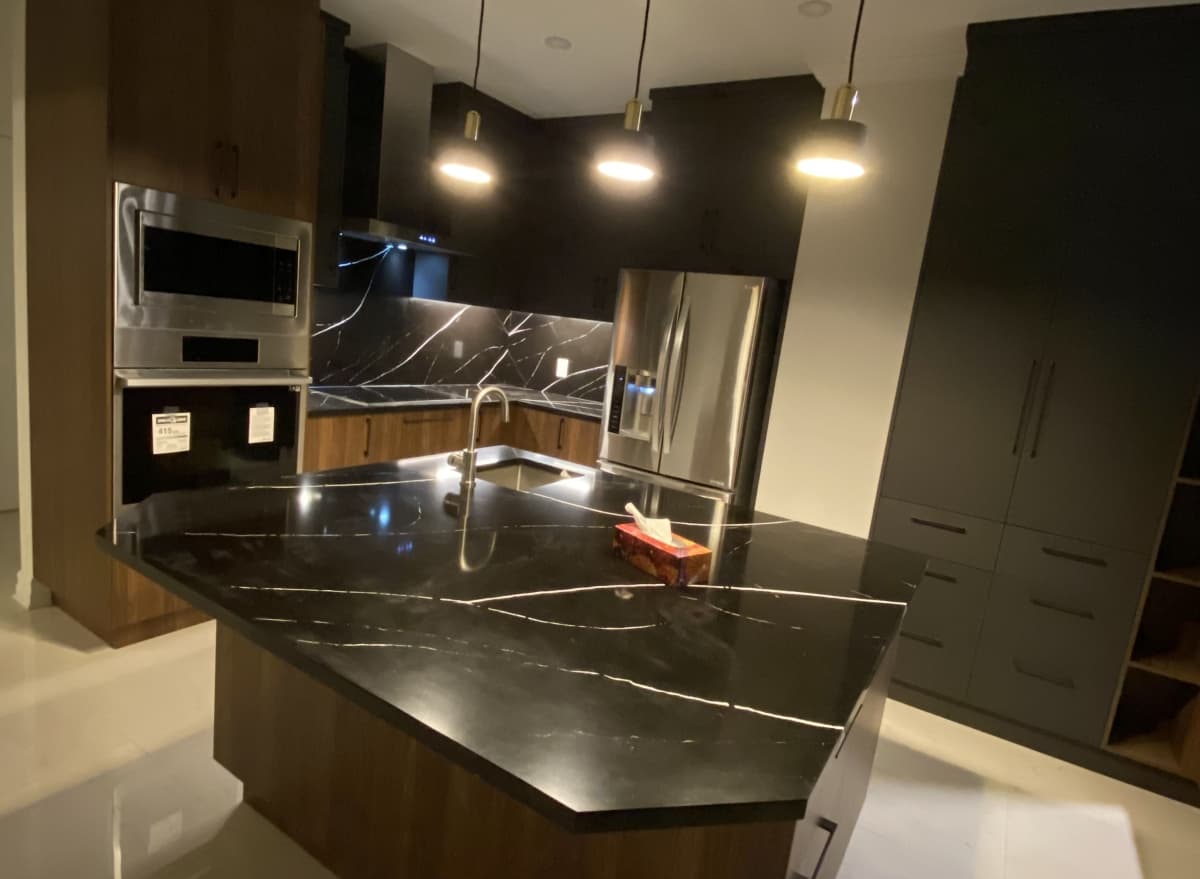
Quartz vs. porcelain vs. marble — choosing a kitchen counter in Montreal
After 25 years installing countertops across Montreal and the West Island, here is the honest case for and against each of the three materials homeowners actually choose — quartz, porcelain slab, and natural marble.
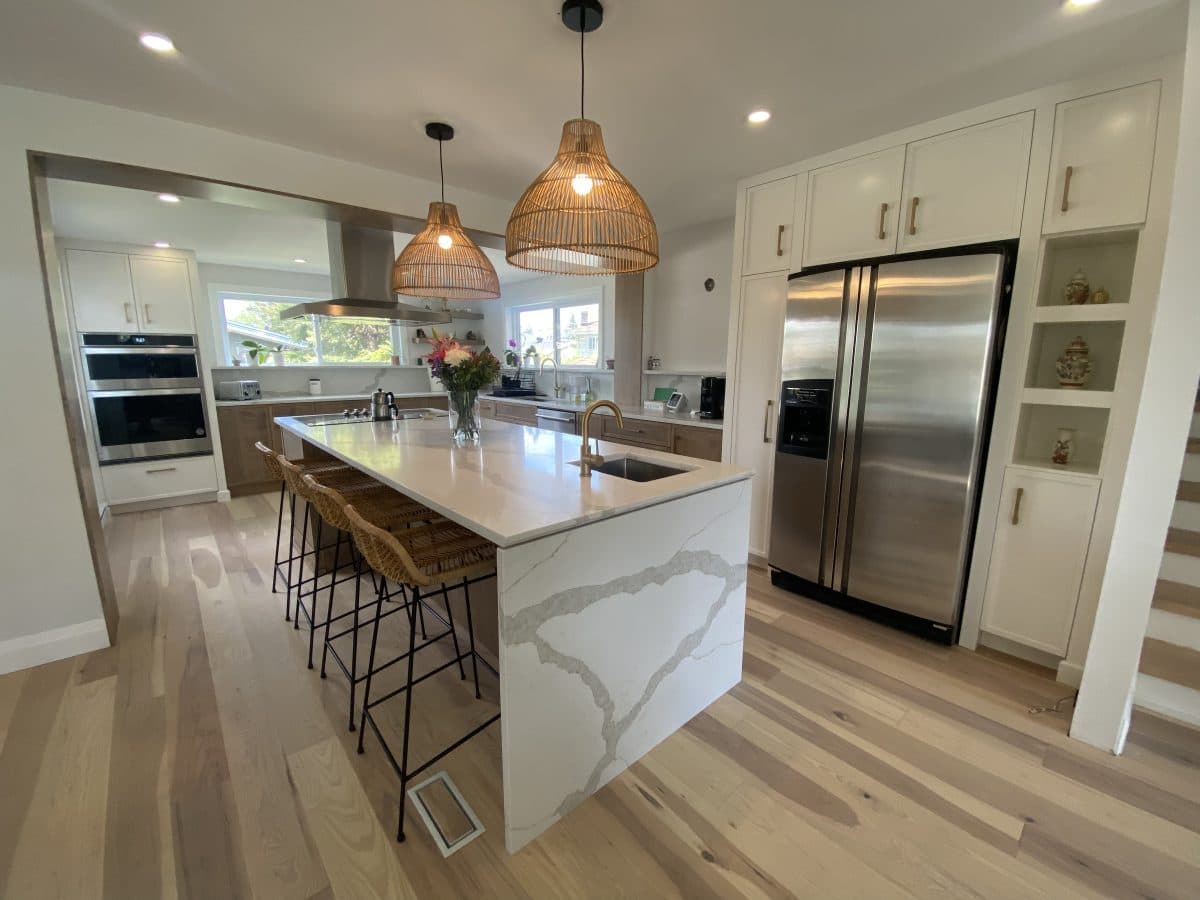
A client in Hampstead last August stood in our showroom in front of three slab samples — a Caesarstone Calacatta-style quartz, a Lapitec porcelain, and a real Calacatta Gold marble — and asked the question we hear once a week: "Which one would you put in your own kitchen?" The honest answer is that two of us at Revohouse have quartz at home, one has porcelain, and one — Sadio — has marble. The right counter depends on how you cook, who lives with you, and how much you care about the patina that develops on a natural stone over a decade. Here is the practical comparison we walk every Montreal client through.
Quartz — the safe choice that's gotten better
Engineered quartz is about 90% ground natural quartz held together by 7–10% polymer resin. The big names in Montreal are Caesarstone, Silestone, Cambria, and Hanstone. In 2026, quartz remains the West Island default, and for most clients it should.
Strengths:
- Truly non-porous; nothing stains it short of permanent marker
- No sealing, ever
- Reliable matching across slabs from the same batch
- Pricing predictable: $90–$140/sqft installed in 2026
- Lead times in Montreal: 2–4 weeks from approved drawings
Weaknesses:
- Heat-sensitive. Dropping a hot pan on quartz can leave a permanent mark. Trivets aren't optional.
- The cheaper white-and-grey vein patterns can read flat in real lighting compared to natural stone
- Polymer resin yellows slightly under direct UV — almost never a problem indoors but noticeable on outdoor kitchens
Best for: primary kitchens in family homes, rental units, condo kitchens with limited natural light, anywhere a non-porous low-maintenance surface matters more than a one-of-a-kind veining pattern.
Porcelain slab — the material that climbed fastest
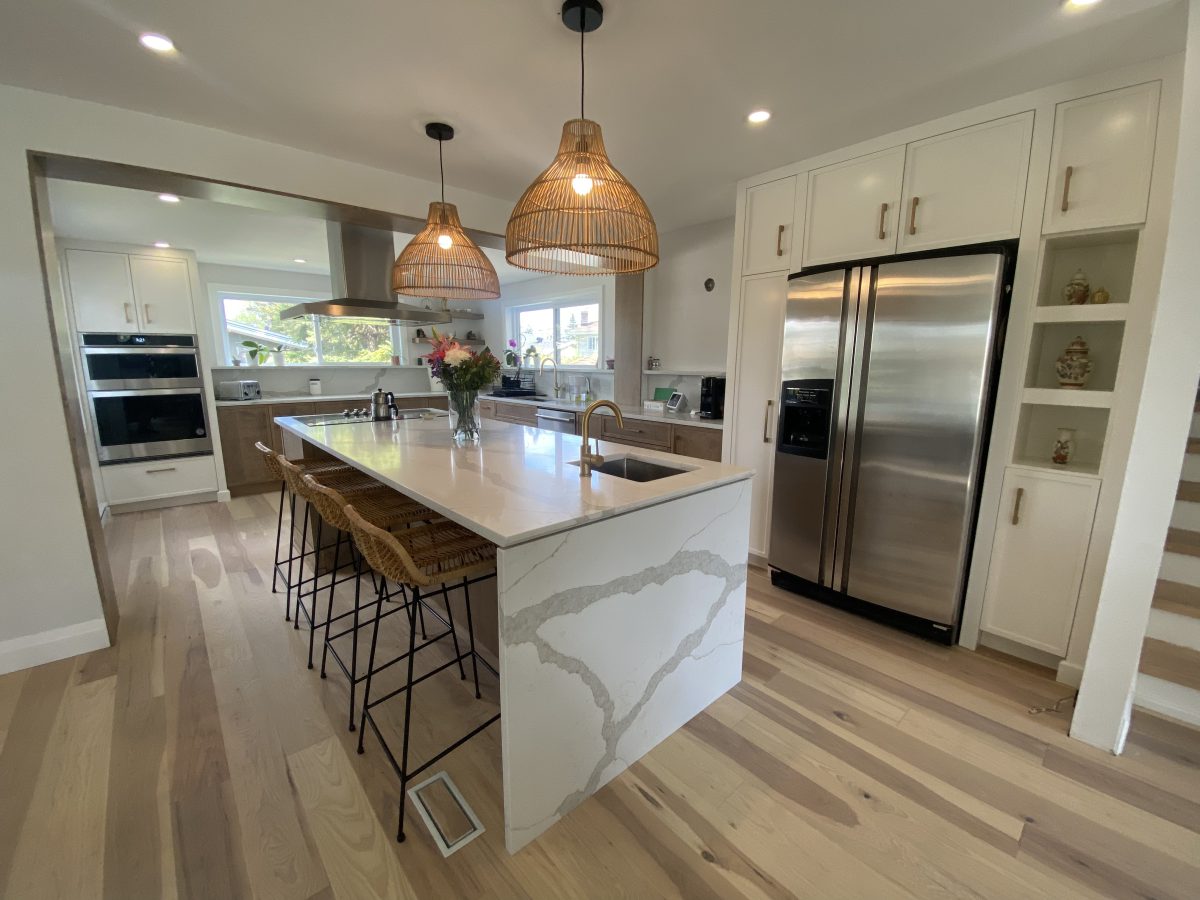
Large-format porcelain slabs — Neolith, Dekton, Lapitec, Laminam — were a commercial product five years ago. Now we install them in residential kitchens almost monthly. They are essentially sintered stone, baked at extreme temperature, with mineral pigment matching real stone veining.
Strengths:
- Heat-proof. You can place a 250°C pan directly on porcelain with no damage.
- UV-stable for outdoor kitchens
- Thin slabs (12mm) work on cabinetry where heavier stone wouldn't
- Highly stain-resistant — even harsher than quartz against red wine, turmeric, oils
- Visual range now matches natural marble convincingly
Weaknesses:
- Brittle on the edge. A sharp impact on a mitred corner can chip; repair is hard.
- More expensive than quartz: $140–$240/sqft installed
- Fabricator pool in Montreal is smaller; the slabs need diamond-blade water-cooled cutting and not every shop has the equipment
- Lead times can stretch to 5–8 weeks depending on the slab source
Best for: outdoor kitchens, indoor kitchens where the cook genuinely uses high heat, homes where the look of natural stone is non-negotiable but maintenance has to be zero.
Natural marble — the patina argument
Real marble — Calacatta, Carrara, Statuario, Arabescato — is what high-end Montreal homeowners want when they walk into our showroom and the others suddenly look like compromises. It's also the material we have the most honest conversations about, because the maintenance reality is real.
Strengths:
- Visually unmatched. No engineered material captures the depth of real Calacatta veining under raking light.
- Heat-resistant (more than quartz, less than porcelain)
- Develops a patina over years that some homeowners find beautiful and others hate
- Single source of the slab means no veining repeat across an island
Weaknesses:
- Porous. Acidic spills — lemon juice, tomato sauce, red wine — etch the surface within minutes if not wiped immediately
- Needs annual sealing
- Pricing: $180–$320/sqft installed, with rare Italian marbles climbing past $500/sqft
- Slab matching during install requires the homeowner to be on-site at the fabricator to bookmatch slabs
Best for: primary kitchens in households where someone is genuinely cooking carefully, secondary surfaces (bar tops, vanity counters) where exposure is lower, and homeowners who view a small etch ring as character rather than damage.

The cost comparison on a real Montreal kitchen
For a typical 65 sqft of counter plus a 35 sqft island, installed in 2026:
| Material | Low end | High end | | --- | --- | --- | | Quartz | $9,000 | $14,000 | | Porcelain slab | $14,000 | $24,000 | | Natural marble | $18,000 | $32,000 |
That's installed pricing including fabrication, templating, edge profile, sink and cooktop cutouts, and delivery to a Montreal-area address.
What we actually recommend
After 25 years and several thousand square feet of counter installed across Montreal and the West Island:
- If you're not sure, quartz. It's the answer for 70% of clients.
- If you cook with high heat or want an outdoor counter, porcelain.
- If the kitchen is a design centrepiece and you'll commit to careful use, marble.
Two things to refuse regardless of material:
- Solid surface (Corian-type) for a primary kitchen counter in 2026. Looks dated, scratches visibly, dated value proposition.
- Laminate. Even modern laminate. The savings ($2,500 on a typical kitchen) don't justify the lifetime trade-off.
FAQ
Can I mix materials in one kitchen?
Yes — we do this on about a third of high-end kitchens. Quartz on perimeter counters (durable, dishwasher-zone), marble on a small island where it's the visual star. The trick is matching the colour and finish (honed vs. polished) so the transition reads intentional.
Does Revohouse fabricate counters in-house?
We work with three Montreal-area fabricators we trust. We template, source the slab with you, and supervise installation. Fabrication itself happens at the shop.
How long does counter install take once cabinetry is in?
Templating happens the day cabinets are installed and inspected. Fabrication is 7–14 days. Install itself is one day. Sink and cooktop sit in after install plus 24 hours for silicone cure.
What if a slab gets damaged after install?
Small chips — most fabricators will repair with colour-matched epoxy. Large damage — the slab section has to be replaced, which means new fabrication and possibly a visible seam. Insurance can cover this depending on your policy.
Planning a renovation like this?
Sadio Moghaddam
General contractor · RBQ 5791-0242-01
Sadio Moghaddam has led Revohouse since 2000 and personally signs every quote. First consultations are free and no-obligation.