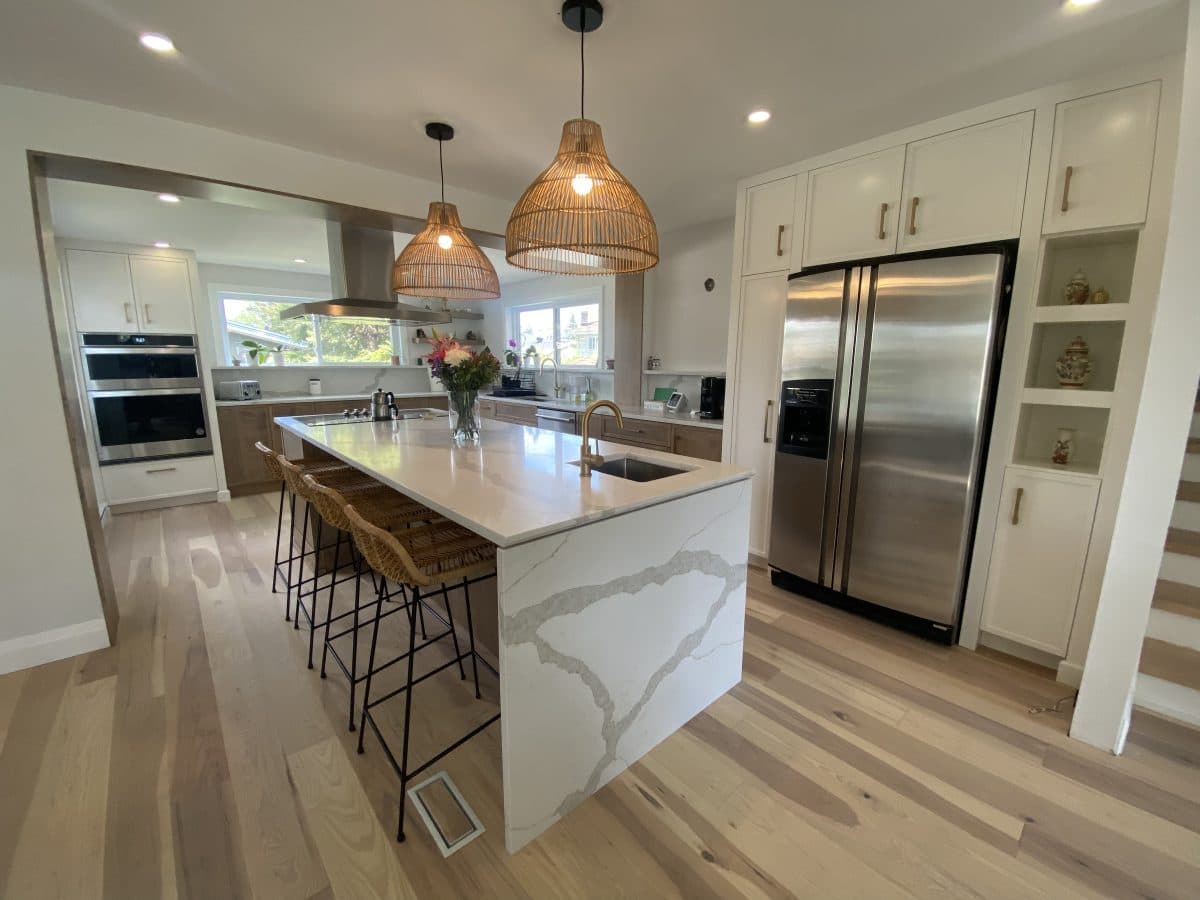
Choosing kitchen cabinets in the West Island — stock, semi-custom, or custom
Cabinetry is 30% of a kitchen budget and the single most visible material in the finished room. Here is how to choose between stock, semi-custom, and full custom for a West Island kitchen — and the trade-offs we have learned the hard way.
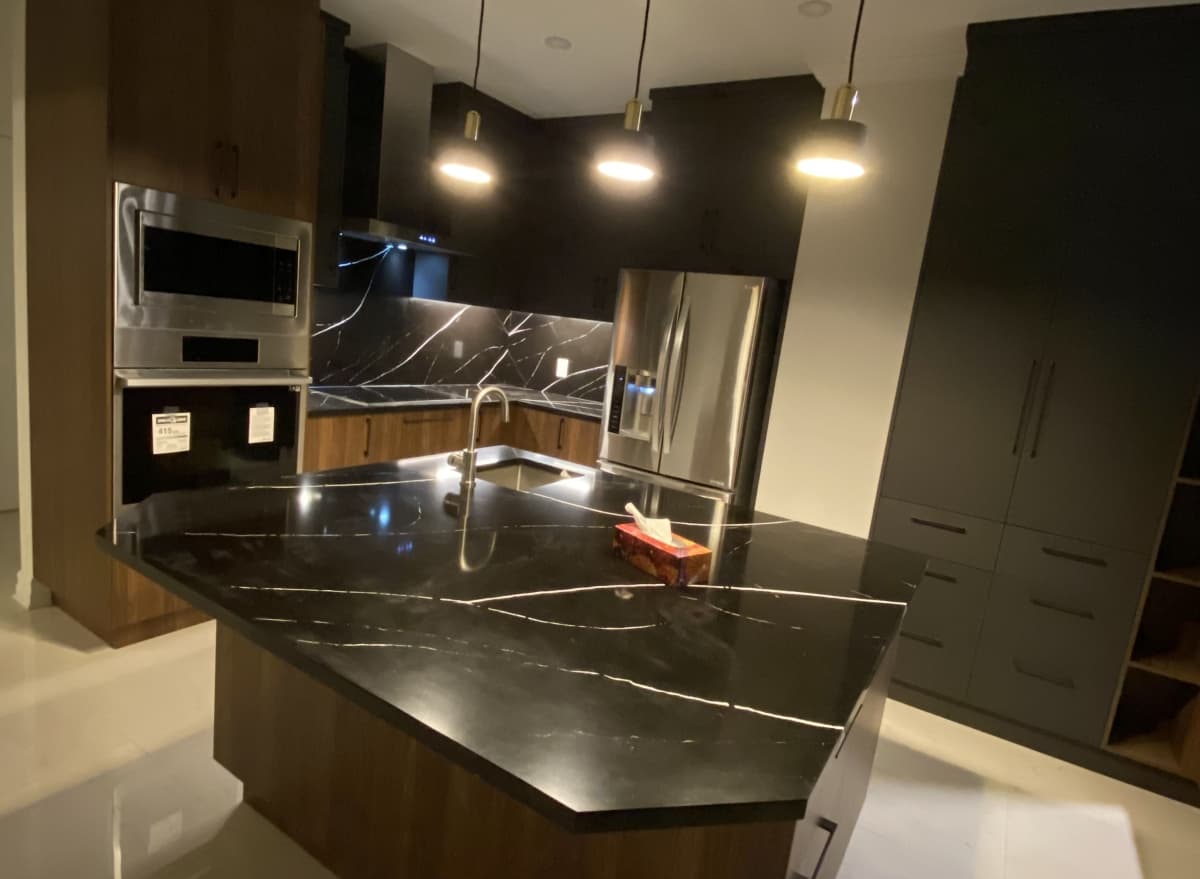
A Kirkland client we worked with two years ago saved $14,000 on her kitchen by choosing semi-custom cabinetry over the full custom she'd originally wanted. She uses the kitchen every day and has never once regretted the choice. A different client in Dollard-des-Ormeaux saved $11,000 the same way and called us six months later because her drawers were sagging under everyday weight. The difference wasn't the price tier. It was what each kitchen actually needed. Cabinetry is the single line item where the right choice is the most context-dependent, and the wrong choice shows up daily for a decade.
This is what we've learned about West Island cabinetry choices.
The three tiers, honestly
Stock (IKEA, big-box, modular catalogue product)
Price: $8,000–$22,000 for a typical 150 sqft West Island kitchen Lead time: in-stock to 2 weeks Where it works: rentals, basement secondary kitchens, small condo kitchens, starter homes Where it fails: any wall longer than 12 feet, any kitchen with non-standard ceiling height, any household that cooks more than four nights a week
Stock cabinetry is much better than it was 20 years ago. IKEA's SEKTION system is genuinely well-engineered and the hardware (Blum-licensed) is excellent. The limitations are in box dimensions (always in 3-inch increments), drawer interior depth, and the cabinet box material itself (particle-board core), which doesn't tolerate water exposure under a sink.
Three honest things about stock:
- Installation labour is almost as much as for semi-custom. The savings are in the cabinetry, not the install.
- Door style options are limited. If the look you want isn't in the catalogue, you're out.
- Resale value impact: a stock kitchen reads as stock to a buyer. In high-end West Island neighbourhoods this can affect listing price more than the savings justified.
Semi-custom (Cabico, Cuisines Steam, Cuisines Verdun, similar Quebec brands)
Price: $22,000–$45,000 for the same 150 sqft kitchen Lead time: 8–14 weeks from approved drawings Where it works: most West Island primary kitchens Where it fails: unusual ceiling heights above 9'6", deeply non-rectangular kitchens, very specific design languages outside the catalogue
Semi-custom is the sweet spot for the majority of West Island homes. Box construction is plywood or solid-core MDF (better than stock particle-board). Doors are available in real wood, real-wood veneer, or factory-painted MDF in any colour. Box dimensions are still modular but with much finer increments and many more sizes.
Three honest things about semi-custom:
- The Quebec brands' quality has caught up to (and in some cases surpassed) imported semi-custom. Buy local; shorter lead times, better service.
- The differences between $30K and $45K semi-custom are subtle. Drawer slides, hinge brand, soft-close mechanisms, interior cabinet finish. They matter, but you don't get a dramatically different-looking kitchen at the higher price.
- The dealer matters more than the brand. A great semi-custom kitchen with a mediocre dealer installs poorly. A merely good kitchen with a great dealer installs well. Our trust list includes specific dealers, not just brands.
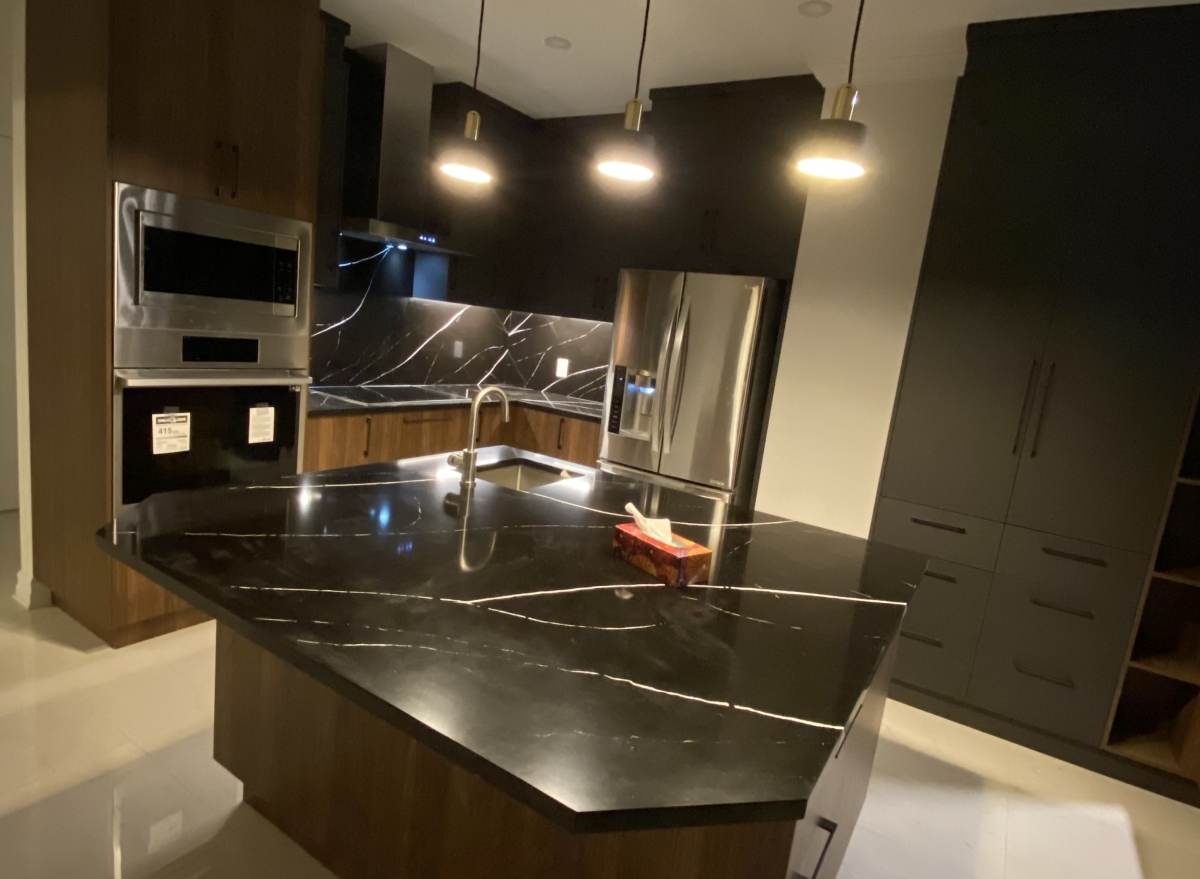
Custom (Montreal millwork shop)
Price: $40,000–$95,000+ for the same 150 sqft kitchen Lead time: 8–12 weeks from approved drawings Where it works: any kitchen where the design has non-standard dimensions, premium materials, or a specific design language; high-end primary kitchens in homes the family intends to keep Where it fails: budgets below $30K of cabinetry, where the additional flexibility doesn't justify the cost
Custom millwork is built to your drawings by a Quebec cabinet shop. Every box is sized to the wall. Every shelf is positioned to the contents you've already told them about. Every drawer interior is finished. The hardware is your choice. The hinges are German. The slides are full-extension and tested to 75 kg per drawer.
Three honest things about custom:
- Custom doesn't always look more "custom." From across the room, a beautifully finished semi-custom kitchen and a custom kitchen are often indistinguishable. The difference shows up in daily use — drawer pulls, soft-close action, interior finish, hidden storage.
- The shop matters more than the brand. There are perhaps 12 millwork shops in Montreal we'd recommend for custom residential. The other shops do mostly commercial work and the residential output suffers.
- Lead times are similar to semi-custom. The myth that custom takes much longer isn't true if the shop is well-managed.
How to choose, in three questions
Ask these in order:
- How long will you live with this kitchen? Less than 5 years: stock or low semi-custom. 5–15 years: semi-custom. More than 15 years: lean custom.
- How many cooks? One cook, occasional: stock works. Two cooks, daily: semi-custom minimum. Two cooks plus entertaining: custom earns its keep.
- How standard are your kitchen's walls? 8'0" or 9'0" ceilings, rectangular footprint, no awkward corners: any tier works. Vaulted ceiling, narrow galley, irregular corners, or older West Island home with no plumb walls: lean custom.
The cabinetry features that matter five years in
After 25 years of doing kitchen warranty walks at year five, here's what consistently separates kitchens that age well from kitchens that don't:
- Plywood or solid-core MDF boxes. Particle-board boxes swell at any sink leak.
- Real soft-close on every door and drawer. Bolt-on aftermarket dampers fail by year three.
- Full-extension drawer slides rated to 75 kg or more. Lighter slides sag with everyday loading.
- Factory-finished interiors. Unfinished cabinet interiors look fine on day one and miserable by year five.
- Adjustable shelves on metal pins, not plastic. Plastic pins crack under load.
If a cabinet spec doesn't include all five, push back regardless of brand.

What we recommend, by household
After 25 years of West Island kitchens:
- Empty-nesters refreshing for resale: mid-tier semi-custom in a neutral painted finish, classic shaker or slab door, quartz counters
- Young family in long-term home: higher-tier semi-custom with the budget weighted toward smart storage interiors and hardware
- Cook-focused household, primary residence for 15+ years: custom millwork; spend the savings from skipping a built-in coffee station on better hardware throughout
- Rental or basement secondary kitchen: stock; spend nothing extra; replace as a unit in 12 years if needed
FAQ
Does Revohouse fabricate cabinetry in-house?
No. We coordinate with cabinet shops we know well, supervise drawings and installation, and stand behind the finished work. Most of the Montreal cabinet shops we use have been our partners for 15+ years.
Can I mix cabinetry tiers in one kitchen?
Sometimes. We've done a project where the perimeter cabinets were semi-custom and the island was custom millwork in a contrasting wood. Done thoughtfully, mixing tiers can save 15–25% on cabinetry cost.
How long do high-quality kitchen cabinets last?
A well-built semi-custom or custom kitchen, in a household with reasonable use, runs 18–25 years before doors or boxes need significant attention. Hardware (hinges, slides) is typically replaced once at year 10–12.
Is real wood always better than painted MDF?
No. Painted MDF in a well-prepped factory finish reads as cleanly as paint-grade wood and is dimensionally more stable. Real wood matters when you specifically want the look of grain — and even then, a real-wood veneer over MDF often outperforms solid wood for stability.
Planning a renovation like this?
Sadio Moghaddam
General contractor · RBQ 5791-0242-01
Sadio Moghaddam has led Revohouse since 2000 and personally signs every quote. First consultations are free and no-obligation.